- info@intelekbva.com
- +1 312-800-1924

Economic Damages Valuation Services
- Home
- Economic Damages Valuation Services
Why Economic Damages Valuations Matter
In litigation, disputes often boil down to one critical question: How much? Whether it’s a breach of contract, intellectual property infringement, business interruption, or wrongful termination, quantifying the financial harm suffered by a party requires specialized expertise in economic damages valuation.
An inaccurate or poorly supported damages calculation can have profound consequences. It can lead to an unjust judgment, undermine settlement negotiations, prolong costly litigation, and expose a party to significant financial risk. Judges, juries, and arbitrators rely on objective, credible expert testimony to translate complex financial impacts into a clear, defensible monetary figure. This demands an independent, accredited appraiser who combines deep financial expertise with a strong understanding of legal principles such as causation, foreseeability, and mitigation.
InteleK’s team of accredited valuation specialists provides independent, defensible economic damages analyses specifically tailored for litigation and dispute resolution. We work diligently to ensure that our conclusions are robust, transparent, and built on state-of-the-art forensic and valuation processes that withstand the scrutiny of opposing counsel, judges, and juries. Our goal is to provide clarity and support fair and efficient resolution.
Book a Free Consultation Call
One of InteleK´s accredited appraisers is available to listen to your story and answer any questions you may have.



Key Principles & Methodologies for Damages Quantification
Quantifying economic damages is a specialized field that adheres to established legal and economic principles. Our approach integrates these principles with rigorous financial analysis.
Foundational Principles:
- Causation: Damages must be directly caused by the wrongful act. We establish the causal link between the defendant’s actions and the plaintiff’s alleged losses.
- Foreseeability: Damages must be reasonably foreseeable at the time the wrongful act occurred.
- Mitigation: The injured party has a duty to take reasonable steps to mitigate their damages. We assess whether appropriate mitigation efforts were made.
- Reasonable Certainty: Damages cannot be speculative; they must be proven with reasonable certainty.
Damages Methodologies:
- Lost Profits Analysis:
- “But-For” World Construction: Developing a credible financial projection of what the plaintiff’s profits would have been without the wrongful act.
- Before-and-After Method: Comparing the plaintiff’s financial performance before and after the damaging event.
- Yardstick Method: Using the performance of comparable businesses unaffected by the wrongful act as a benchmark.
- Diminution in Business Value: A business valuation comparing the value of a business or asset before and immediately after the damaging event. This is often applicable when the wrongful act has a permanent impact on the business’s earning capacity or market position.
- Reasonable Royalty Analysis: For IP infringement, this involves determining a hypothetical royalty rate that would have been negotiated between willing parties for the use of the infringed intellectual property.
- Lost Earnings/Wages: For individual damages, projecting lost income, benefits, and earning capacity over a relevant period.
- Increased Costs: Quantifying additional expenses incurred by the plaintiff due to the defendant’s actions.
Discounting to Present Value
Future damages (e.g., future lost profits or future lost earnings) must be discounted to their present value as of the date of trial or settlement. We apply appropriate discount rates to ensure the damages award reflects the time value of money.
The Economic Damages Quantification Process
Our process for quantifying economic damages is thorough and designed for maximum defensibility:
- Data Collection & Forensic Review: We gather and meticulously review all relevant financial, operational, and legal documents, including historical financial statements, tax returns, contracts, industry reports, and expert reports from other disciplines. Our forensic approach helps uncover irregularities or hidden financial impacts.
- Case Theory & “But-For” World Development: In close collaboration with legal counsel, we develop a robust understanding of the case theory and construct a credible “but-for” scenario that accurately reflects what would have happened absent the wrongful act.
- Damages Model Development: We build sophisticated financial models to quantify damages using the most appropriate methodologies. These models are transparent, logically sound, and designed to withstand rigorous scrutiny.
- Assumptions & Sensitivity Analysis: We clearly articulate all key assumptions underlying our damages calculations. We also perform sensitivity analyses to demonstrate how damages vary under different reasonable assumptions, providing a comprehensive range of potential outcomes.
- Expert Report Generation: We prepare a comprehensive, well-written expert report that clearly presents our findings, methodologies, and conclusions, adhering to all legal and professional standards.
- Rebuttal & Critique: We are also engaged to critique opposing expert reports, identifying weaknesses in their methodologies, assumptions, or conclusions.
Expert Witness Testimony & Litigation Support
The ability to clearly and credibly present complex financial analysis in a courtroom or arbitration setting is crucial. Our role extends beyond report writing to active litigation support.
Expert Witness Testimony
Our accredited appraisers are experienced in providing clear, concise, and credible expert witness testimony in depositions, mediations, arbitrations, and trial settings. We effectively communicate intricate financial concepts to judges, juries, and arbitrators, defending our damages conclusions under rigorous cross-examination. We simplify the complex, making our analysis understandable and persuasive.
Collaboration with Legal Teams
We work seamlessly with trial attorneys, forensic accountants, and other legal professionals from discovery through resolution. We provide strategic insights, assist in preparing for depositions, develop demonstratives, and help formulate cross-examination questions for opposing experts, ensuring our analysis fully supports the legal strategy.
InteleK’s Economic Damages Valuation Approach
Our accredited appraisers bring deep expertise in forensic accounting, business valuation, and economic damages quantification to every litigation engagement. Here’s what sets our process apart:
Forensic Rigor & Data Integrity — Our detailed forensic analysis ensures the integrity of financial data, identifying and adjusting for irregularities, and building damages models on a sound factual basis.
Defensible Methodologies — We apply established economic and valuation methodologies that are legally sound, empirically supported, and designed to withstand the most rigorous cross-examination.
Clear & Compelling Communication — We pride ourselves on simplifying complex financial concepts, making our expert reports and testimony clear, understandable, and persuasive to judges, juries, and arbitrators.
Seasoned Expert Witnesses — Our appraisers are experienced in all phases of litigation, from initial case assessment and discovery to deposition and trial testimony, providing compelling and credible expert witness services.
Customized “But-For” Analysis — We meticulously construct a “but-for” world scenario tailored to the specific facts and legal theory of each case, ensuring our damages calculations are directly tied to the alleged wrongful act.
Comprehensive Damages Quantification — We quantify a full spectrum of economic damages, including lost profits, diminution in business value, reasonable royalty, and lost earnings, providing a holistic assessment of financial harm.
Strategic Partnership — We integrate seamlessly with your legal team, providing timely insights and strategic support throughout the entire dispute resolution process, from initial assessment to trial.
our team
Meet InteleK’s Leaders

Andrew Mackson, CFA, ABV
co-founder & Partner
Cameron Braid,
MBA
Co-Founder & Partner 
Ryan Maguire,
Valuation Expert
Director of Business valuations 


Economic Damages Valuation Services FAQs
Expert insights into quantifying lost profits, diminution in value, reasonable royalty, and expert testimony in 2026.
⚠️ General information only. InteleK Business Valuations & Advisory Pty Ltd recommends professional legal and financial advice for all litigation matters.
Search 2026 Economic Damages & Litigation Topics
Economic damages represent the financial losses suffered by an individual or entity as a direct result of a wrongful act. Quantifying these damages involves comparing the "actual world" (what happened) to the "but-for world" (what would have happened if the wrongful act had not occurred).
Common cases include breach of contract, intellectual property infringement, business interruption, shareholder and partnership disputes, commercial torts (e.g., fraud, unfair competition), personal injury, wrongful death, and wrongful termination. Any dispute where financial harm is alleged typically requires economic damages quantification.
A "but-for" analysis is fundamental to economic damages. It involves constructing a hypothetical financial scenario ("but-for world") of what would have happened if the wrongful act had not occurred. The difference between this "but-for" scenario and the "actual world" (what actually happened) represents the economic damages.
Lost profits are typically calculated by projecting what the plaintiff's profits would have been in the "but-for" world and subtracting the actual profits realized. Common methods include the "before-and-after" method (comparing performance before and after the event) or the "yardstick" method (using comparable businesses as a benchmark).
Diminution in value quantifies the permanent reduction in the value of a business or asset due to a wrongful act. It's used when the harm has a lasting impact on the asset's earning capacity, market position, or salability. This often involves a business valuation comparing the asset's value before and immediately after the damaging event.
For intellectual property (IP) infringement cases, a "reasonable royalty" analysis determines the hypothetical royalty rate that a willing licensor and licensee would have negotiated for the use of the infringed IP, absent the infringement. This often serves as a measure of damages when lost profits are difficult to prove or are not the appropriate measure.
Yes. A fundamental principle of economic damages is that future losses (e.g., future lost profits or future lost earnings) must be discounted to their present value as of the date of trial or settlement. This accounts for the time value of money, ensuring the damages award reflects the current equivalent of future losses.
An economic damages expert witness quantifies the financial harm suffered, prepares a comprehensive expert report, and provides clear, credible testimony in depositions, mediations, arbitrations, or trial. They translate complex financial analysis into understandable terms for judges, juries, and arbitrators, helping them make informed decisions.
Damages must be directly *caused* by the wrongful act, and the harm must have been reasonably *foreseeable* at the time the act occurred. Our analysis ensures that the damages quantified are directly linked to the alleged wrongful conduct and meet these legal thresholds, minimizing vulnerability to challenge.
Key documents typically include historical financial statements (income statements, balance sheets, cash flow statements), tax returns, internal budgets/forecasts, contracts relevant to the dispute, industry reports, and information on any mitigation efforts. A detailed request list will be provided at the outset of the engagement.
No economic damages topics found matching your search. Try keywords like "lost profits", "diminution in value", "reasonable royalty", or "expert testimony".
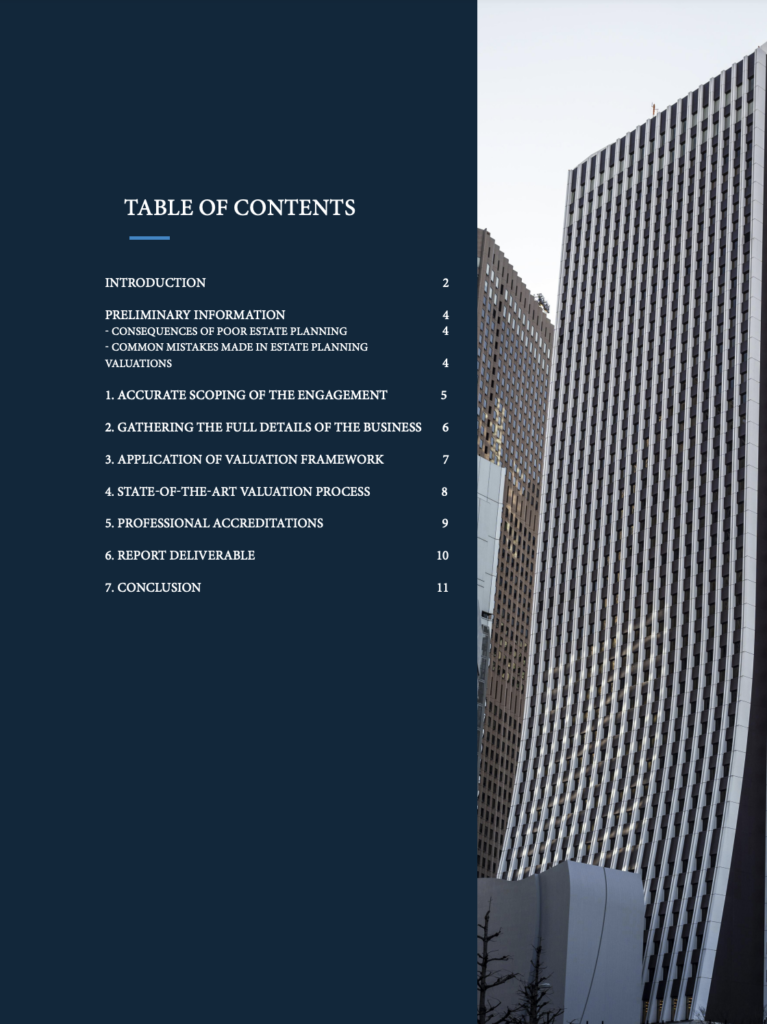
Downloadable Ebook – Estate Planning for Business Owners & Their Advisors – A Guide Through the Business Valuation Process.